
 Written by: Jyoti Madhusoodanan, Ph.D. | Issue # 135 | 2026
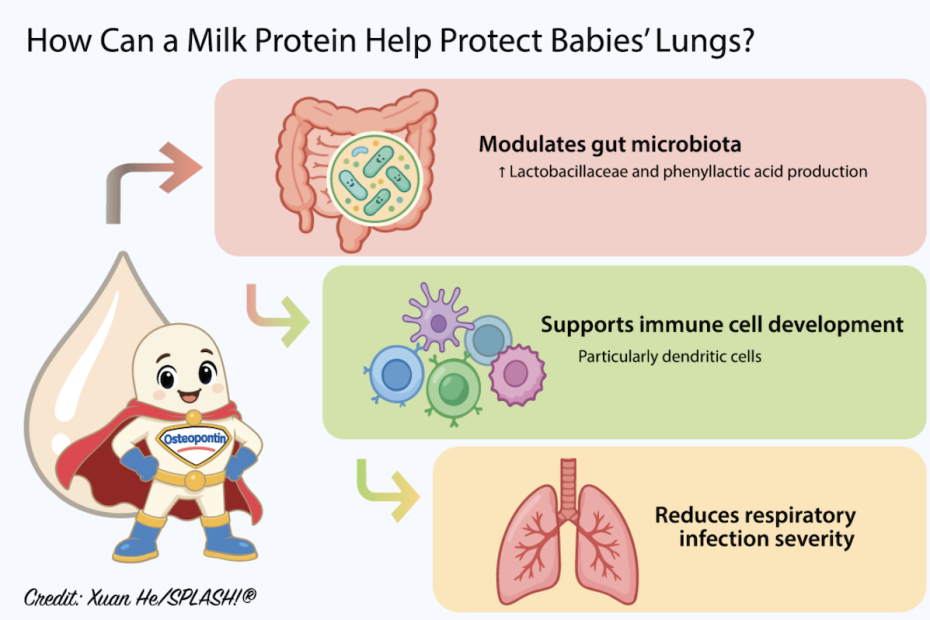
- Osteopontin (OPN) in maternal milk protects newborn mice from severe viral and bacterial respiratory infections.
- OPN-deficient mice had lower levels of cellular signals that drive tissue-resident immune cell maturation in the lungs, liver, and other tissues.
- OPN effects were a result of oral consumption and mediated by the gut microbiome.
- The serum metabolite D-PLA mediated OPN’s effects on immune cells.
Osteopontin (OPN) is a protein with many functions: it governs mineral deposition in bones, inflammation, and immune development and other cellular functions. Animal studies have linked OPN deficiency to more severe viral and bacterial respiratory infections.
Human studies have also hinted at a link to immunity: OPN is abundant in human colostrum and breastmilk, and high levels of this protein are correlated with lower rates of hospitalization due to fever in infants. In various studies, researchers have reported that supplementing infant formula with bovine milk-derived OPN reduced incidence of fever in 4-month-old infants, and that osteopontin supplementation was linked with higher levels of circulating T cells in 6-month-olds, suggesting that the protein somehow affects immunity [1,2]. But OPN’s precise functions during infant development were a mystery.
In a new study, Simon Phipps of the QIMR Berghofer Medical Research Institute in Australia and his colleagues set out to investigate this connection [3]. Osteopontin is prevalent in two forms – an intracellular version and the secreted form found in breastmilk. To prevent confounding between the two forms, the researchers engineered mice that lacked the OPN gene so that their only source of the protein was through milk or supplements.
To investigate OPN’s role, the team cross-fostered wild-type mice with OPN-producing or OPN-deficient mothers one day after birth. On the tenth day after birth, mice were inoculated with either PVM, a virus that causes pneumonia in mice, or the bacterial pathogen Streptococcus pneumoniae. They supplemented the animals’ diet with one of two forms of a supplement: one group received a supplement that contained physiological levels of OPN, and the other received a depleted form with 100-fold lower levels of the protein.
Mice who were fostered by OPN-deficient mothers and who received the depleted supplement had lower weight gain and increased levels of virus in their lungs. They also showed signs of airway epithelial sloughing, more mucus production, and neutrophil inflammation – all signs of more severe disease. Milk-derived OPN supported infant immune development and reduced the severity of respiratory infections, as animals that received the high-OPN supplement had lower levels of pathogens, less severe disease, and better weight gain.
Analyzing immune signals revealed that OPN-deficient mice had lower levels of growth factors such as Flt3L and IL-34, which support growth of tissue-resident immune cells in the liver, lung, and other sites. “We looked at the infant lung cells that line the airways when the osteopontin was missing,” Phipps said in a press release. “It was like night and day.”
But levels of these factors were restored when the animals’ diet included an OPN supplement, suggesting that OPN supports the development of tissue-resident immune cells in the neonatal lung.
In a subsequent experiment, the researchers found that an intra-peritoneal injection of OPN did not confer the same immune benefits as the oral OPN supplement, hinting at a role for the gut microbiome. To confirm this, the team enriched fecal microbiomes from newborns who had received the OPN-containing supplement and those that had been fed the depleted version. Then, they transplanted those fecal communities into OPN-deficient mice. When infected with PVM, mice that received microbes from OPN-depleted animals developed severe infections and had lower levels of lung immune cells than the group that received transplants from mice fed the OPN-enriched supplement.
Analysis of the microbiome revealed differences in the relative abundance of several species, especially various Lactobacilli sp., between OPN-deficient and OPN-normal animals. Serum metabolites were also different between these two groups, particularly with regard to molecules important for cellular energy, such as NAD+. One other metabolite stood out to the team: DL-3-phenyllactic acid (PLA), which is associated with exclusive breastfeeding and lactic acid bacteria. The researchers also confirmed that D-PLA was upregulated when animals were fed an OPN-supplemented diet.
Like the OPN-supplemented diet itself, feeding mice with D-PLA spurred immune cell development and maturation in the lungs and liver. The researchers found that D-PLA appeared to mediate its effects via a receptor known as PPARγ in epithelial cells. This molecule was barely detectable in OPN-deficient newborns, but its levels increased with either OPN or D-PLA supplements. The team also found that supplementing with a drug named rosiglitazone, which mimics the effects of PPARγ, spurred immune development similar to OPN itself.
Oral D-PLA supplements also protected newborn mice from viral and bacterial pneumonia infections, lowering pathogen load, reducing inflammation and preventing stunted weight gain. The supplement also minimized the harms of antibiotics in OPN-deficient animals – highlighting its potential as an adjunct therapy.
Together, the data “elucidate a causal pathway,” connecting the dots between lower consumption of breastmilk and increased risk of severe lower respiratory tract infections, as the authors wrote in their study. The results also pave the way for future therapies; milk compounds such as OPN or some form of PLA may be eventually developed to support neonatal immunity and reduce the risk of severe respiratory illness.
References
- Lönnerdal B, Kvistgaard AS, Peerson JM, Donovan SM, Peng YM. Growth, nutrition, and cytokine response of breast‐fed infants and infants fed formula with added bovine osteopontin. J Pediatr Gastroenterol Nutr. 2016 Apr;62(4):650-7.
- West CE, Kvistgaard AS, Peerson JM, Donovan SM, Peng YM, Lönnerdal B. Effects of osteopontin-enriched formula on lymphocyte subsets in the first 6 months of life: a randomized controlled trial. Pediatr Res. 2017 Jul;82(1):63-71.
- Howard DR, Rashid RB, Ahmed T, Namubiru P, Rana MS, Wilkins T, et al. Milk osteopontin alters the infant microbiome to drive DC hematopoiesis and disease tolerance. Cell. 2026 Aug 3.